
40 Best Perennial Plants to Hide Ugly Views
In this post, learn magic tricks to make ugly views disappear.
Table of Contents
Why hide views with plants?
Why would you hide anything with plants, right? You wake up in the morning, brew your coffee, walk up to the window to look at your garden. It grows in the land of your dreams, that you have picked yourself and purchased, that lies in pristine meadows, surrounded by luxurious old-growth forests and majestic mountains. You can’t decide what to look at, because everything there is just perfect.
Yeah, right.
This might be true for some of us, and if you are that person, lucky you—you should enjoy those views. We all want to be you.
For the rest of us, the picture looks more or less like this:
You wake up in the morning, brew your coffee, walk up to the window to look at your beautiful garden. You really try to concentrate on the beautiful garden, because right behind it creeps that old, half-dilapidated building that looks like it’s about to topple onto that beautiful garden of yours, probably releasing ghosts of ancient peasants from its rusty grip. Or just rats. You can do nothing about it, since it’s not on your property, so you hope a tiny tornado appears one day, just on that specific spot, just enough to get rid of that building—not your garden, of course.
Oh, and there is that tall cement utility pole that just had to be on your land. Sometimes you wonder if electricity is all that important to you… a tree would look better there.
As you sip your coffee, you notice all those structures that you cannot control. All you can do is hide them. Any good garden magician knows how to make structures disappear in plants.
And you are a garden magician. If you don’t feel like one yet, you will by the end of this post.
NOTE:
- I wanted to give information in an organized way, and since I’ve been a fan of excel since I found out what excel was, I put everything in tables. I sorted it into sections: Trees, Vines, Shrubs, Grasses and Moss and wrote their zones, sizes, growth rate and so on.
- I believe pictures of all the plants I mention are extremely important, but if I included them all here, this post would scroll you into oblivion, so here you have the concise info, and below each section I will put a link to blog posts that contain the pictures for that particular section along with basic tree info.
TREES
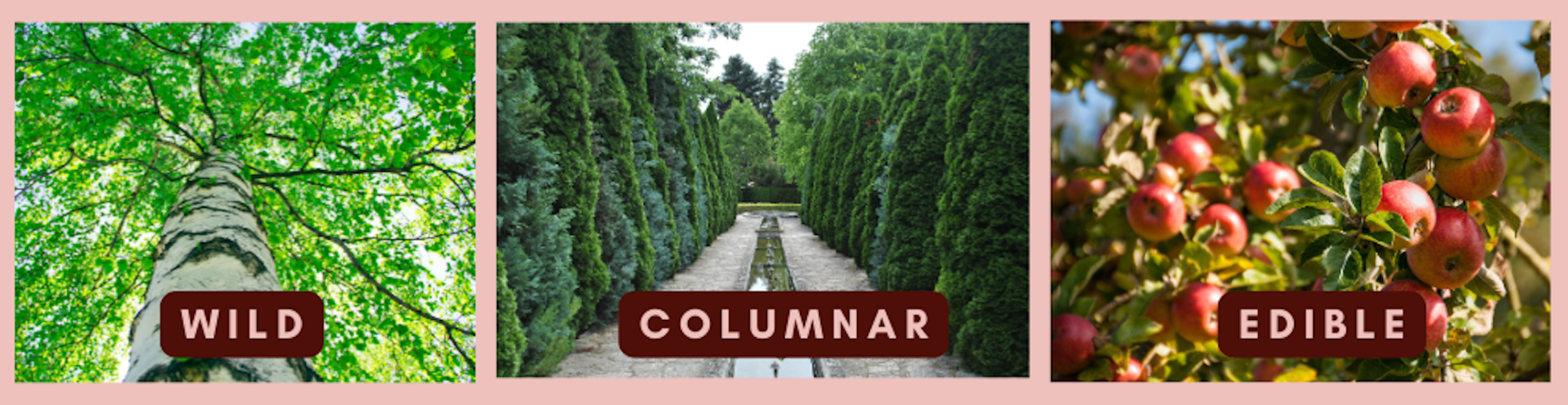
Trees would probably be your first thought as best perennial plants. And rightfully so. My favorite magic trick isn’t trees, but I’ll start with them because they are the biggest.
Pros:
- Look good, especially over time when they are fully mature
- Provide shade
- Create Oxygen
- Give birds, mushrooms, bugs a space to live
Cons:
- Require space
- Some trees can compete with veggies for water and nutrients
- Require time to grow to the desired size to hide the undesirable object
Here are some good trees to consider.
Wild vibe – forest trees, large in size
| Tree Name | Latin Name | Zone | Evergreen? | Mature Height (m) | Crown Spread (m) | Growth Rate | Veggie Competition |
| Eastern Red Cedar | Juniperus virginiana | 2–9 | Yes | 12–18 | 6–10 | Fast | Medium |
| White Pine | Pinus strobus | 3–8 | Yes | 20–30 | 8–12 | Medium | Medium |
| Norway Spruce | Picea abies | 3–7 | Yes | 25–35 | 8–12 | Fast | Medium |
| Linden (Basswood) | Tilia cordata | 3–7 | No | 18–24 | 10–15 | Medium | Medium |
| Birch | Betula pendula | 2–7 | No | 15–25 | 6–10 | Fast | High |
| Juneberry | Amelanchier lamarckii | 4–9 | No | 6–9 | 4–6 | Fast | Low |
| Hazel | Corylus avellana | 4–8 | No | 4–6 | 4–6 | Medium | Medium |
| Amur Maple | Acer ginnala | 3–8 | No | 4–7 | 4–7 | Fast | Medium |
French garden vibe – geometric shapes, not too tall, shrubby or columnal
| Tree name | Latin name | Growing zone | Evergreen | Mature height (m) | Crown spread (m) | Growth rate | Veggie competition |
| Pyramidal Austrian pine | Pinus nigra pyramidalis | 4–7 | Yes | 10-15 | 3–5 | Medium | Medium |
| Emerald Green Arborvitae | Thuja occidentalis ‘Smaragd’ | 2–7 | Yes | 4–6 | 1–1.5 | Medium | Medium |
| Armstrong Red Maple | Acer rubrum ‘Armstrong’ | 4–9 | No | 12–18 | 4–6 | Fast | High |
| Columnar Hornbeam | Carpinus betulus ‘Fastigiata’ | 4–8 | No | 10–15 | 3–5 | Slow | Medium |
| Columnar Serviceberry | Amelanchier ‘Obelisk’ | 3–9 | No | 4–6 | 2–3 | Medium | Low |
Practical vibe – edible fruit trees!
Great addition to your diverse garden to attract pollinators, birds and enjoy the edibles.
| Tree name | Latin name | Growing zone | Evergreen | Mature height (m) | Crown spread (m) | Growth rate | Veggie competition |
| Apple | Malus domestica | 3–8 | No | 3–8 (depends on rootstock) | 3–6 | Medium | Medium |
| Pear | Pyrus communis | 4–8 | No | 4–10 | 3–6 | Medium | Medium |
| Cornelian Cherry | Cornus mas | 4–8 | No | 4–7 | 3–5 | Slow | Low |
| Sorbus cashmiriana (or your local sorbus) | Sorbus cashmiriana | 5–7 | No | 6–10 | 4–6 | Medium | Medium |
| Pawpaw | Asimina triloba | 5–9 | No | 3–6 | 2–4 | Medium | Medium |
| Serviceberry (edible berries) | Amelanchier lamarckii | 4-8 | No | 6-9 | 4-6 | Medium | Low |
And here is the link to pin’able pictures of trees!
VINES
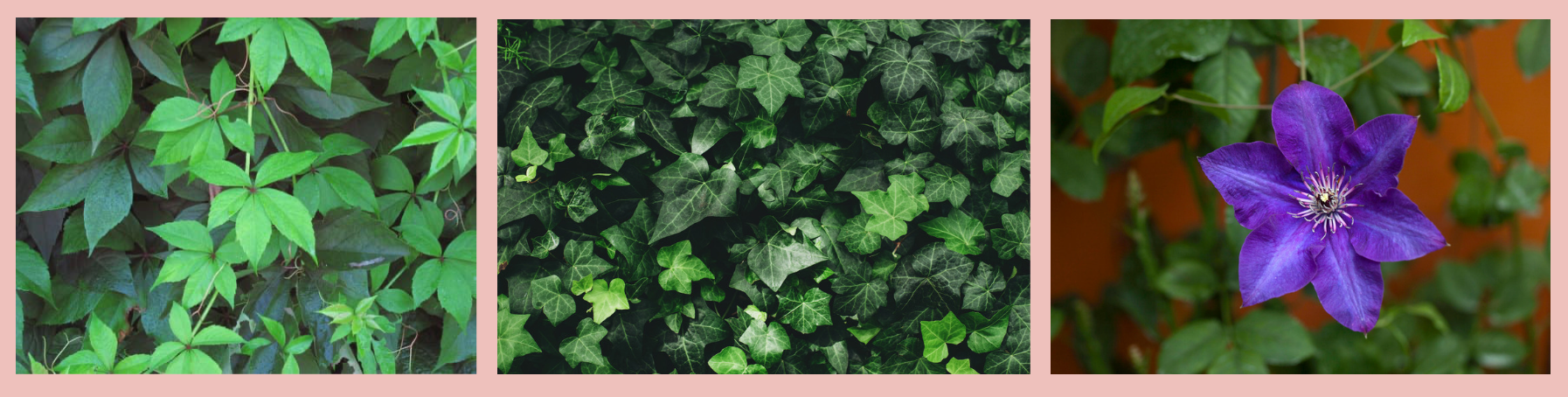
These are actually my favorite. If you don’t mind a little wilderness, they will grow like crazy on anything.
I’ve got English Ivy and Virginia Creeper knitting nice green blankets around all my ugly structures.
Note: English Ivy is considered invasive in some places and highly aggressive in others. Where I am, you are advised not to grow them near forests, so they don’t become invasive. Since I had them growing for years in a couple of places and they were nowhere near my veg nor the forest, I decided to leave them, because I love them. They stay green in winter if temperatures are not constantly below zero, and cover surfaces fast.
Pros:
-Grow fast
– Low maintenance
- Some are evergreen depending on your zone
- Are thick bottom-up (unlike trees that have crowns, but the trunks won’t hide much)
Cons:
- need structures to climb on
- If you let them cling to stucco on your house, if the plant falls, it will take the stucco with it
| Vine Name | Latin Name | Zone | Evergreen? | Size | Growth Rate | Veggie Competition |
| Virginia Creeper | Parthenocissus quinquefolia | 3–9 | No | Large | Fast | Medium |
| Climbing Hydrangea | Hydrangea anomala subsp. petiolaris | 4–9 | No | Large | Medium | Medium |
| Hops (beware – very aggressive!) | Humulus lupulus | 4–9 | No | Large | Fast | Medium |
| Clematis (hardy varieties) | Clematis spp. | 4–9 | No | Medium | Medium | Low |
| Trumpet Honeysuckle (note: mildly toxic) | Lonicera sempervirens | 4–9 | No | Medium | Fast | Medium |
Link to the Vines section with pictures!
SHRUBS
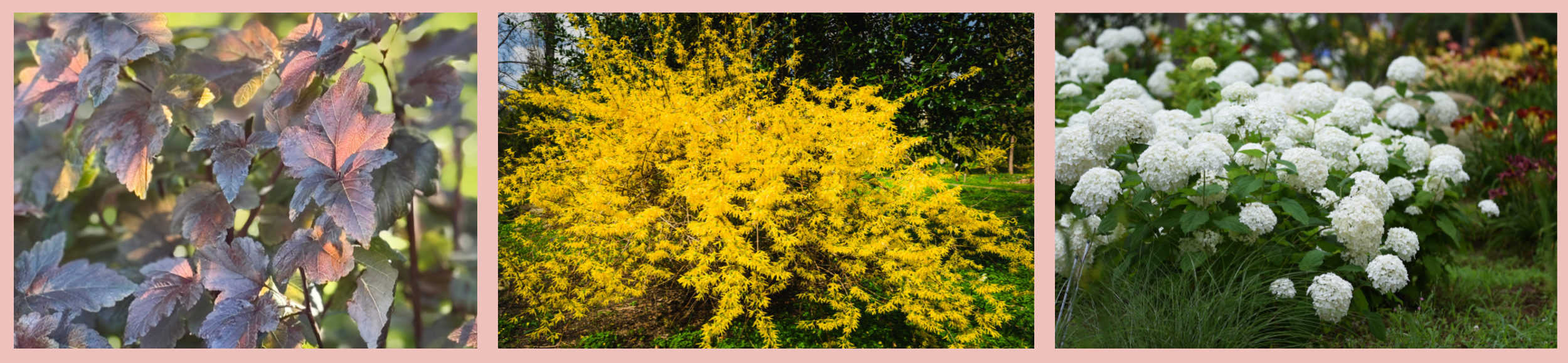
These are mostly for smaller things that need hiding, nevertheless, pretty useful to put instead of rotting fences or on unproductive slopes. And honestly, the Ninebark and Forsythia I’ve got in my garden are almost 3 meters tall and so thick that they are hardly see-through even in winter.
Pros
- Good barriers
- Can be edible
Cons
- require some maintenance
- Won’t hide tall things
| Shrub Name | Latin Name | Zone | Evergreen? | Height (m) | Growth Rate | Veggie Competition |
| Elderberry (berry) | Sambucus canadensis | 3–9 | No | 2–6 m | Fast | Medium |
| Red-Osier Dogwood | Cornus sericea | 3–7 | No | 2–5 m | Fast | Medium |
| Hazel (hazelnut) | Corylus spp. | 4–8 | No | 2–4 m | Medium | Medium |
| Ninebark | Physocarpus opulifolius | 3–8 | No | 1.5–3 m | Fast | Medium |
| Forsythia | Forsythia × intermedia | 5–8 | No | 2–3 m | Fast | Medium |
| Smooth Hydrangea | Hydrangea arborescens | 3–9 | No | 1–2 m | Medium | Low |
| Serviceberry (Saskatoon berry) | Amelanchier alnifolia | 2–7 | No | 1–3 m | Medium | Low |
| Boxwood (cold-hardy) | Buxus sempervirens | 5–9 | Yes | 0.5–2 m | Slow | Low |
Link to the Shrubs section with pictures!
GRASSES
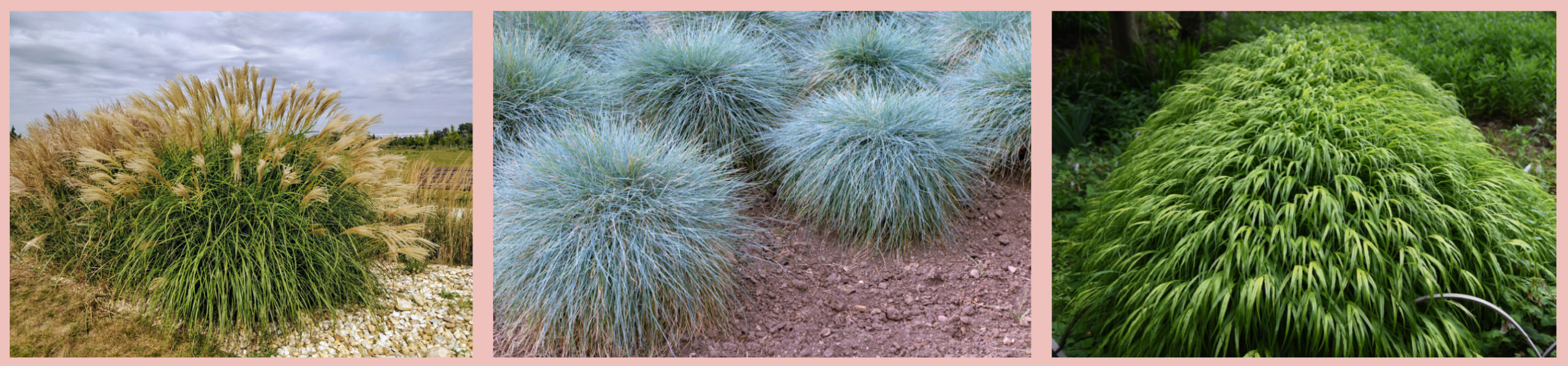
When I was walking the length of New Zealand (a long distance hike called Te Araroa), at some point in the South Island there was a stretch of so much tussock I almost started hating the thing.
It was pretty hard to walk, since it grew in clumps, in wet, swampy areas and was taller than me, so I couldn’t see where I was supposed to walk.
If it could make me disappear for 10 hours a day, for days on end, when planted well, it can make other things disappear from your view too.
Pros:
- Grows fast and, depending on species, tall
- Looks awesome in winter
- Low maintenance
- Drought-resistant
- Look sooooo fluffy and fluid and dreamy when they sway on the wind
Cons:
- I can think of nothing..it’s not as green I guess? Or some of them you can’t cut, you have to sort of “brush” which is slightly annoying
| Grass Name | Latin Name | Zone | Evergreen? | Size | Growth Rate | Veggie Competition |
| Giant Miscanthus | Miscanthus giganteus | 5–9 | No | 2.5–4m | Fast | Medium |
| Feather Reed Grass | Calamagrostis x acutiflora ‘Karl Foerster’ | 4–9 | No | 1.2–1.8m | Medium | Low |
| Little Bluestem | Schizachyrium scoparium | 3–9 | No | 0.6–1.2m | Medium | Low |
| Japanese Forest Grass | Hakonechloa macra | 5–9 | No | 0.3–0.6m | Medium | Low |
| Blue Grama Grass | Bouteloua gracilis | 3–9 | No | 0.2–0.5m | Slow–Medium | Low |
| Blue Fescue | Festuca glauca | 4–8 | No | 0.2–0.4m | Slow | Low |
| Prairie Dropseed | Sporobolus heterolepis | 3–9 | No | 0.6–1.0m | Slow | Low |
MOSS
If you go to the forest and like to lie down on moss, this one’s for you.
Pros
- Looks like a soft, green forest carpet
- Grows on a lot of porous surfaces
Cons
- Stores moisture
- Might attract slugs if in shady areas
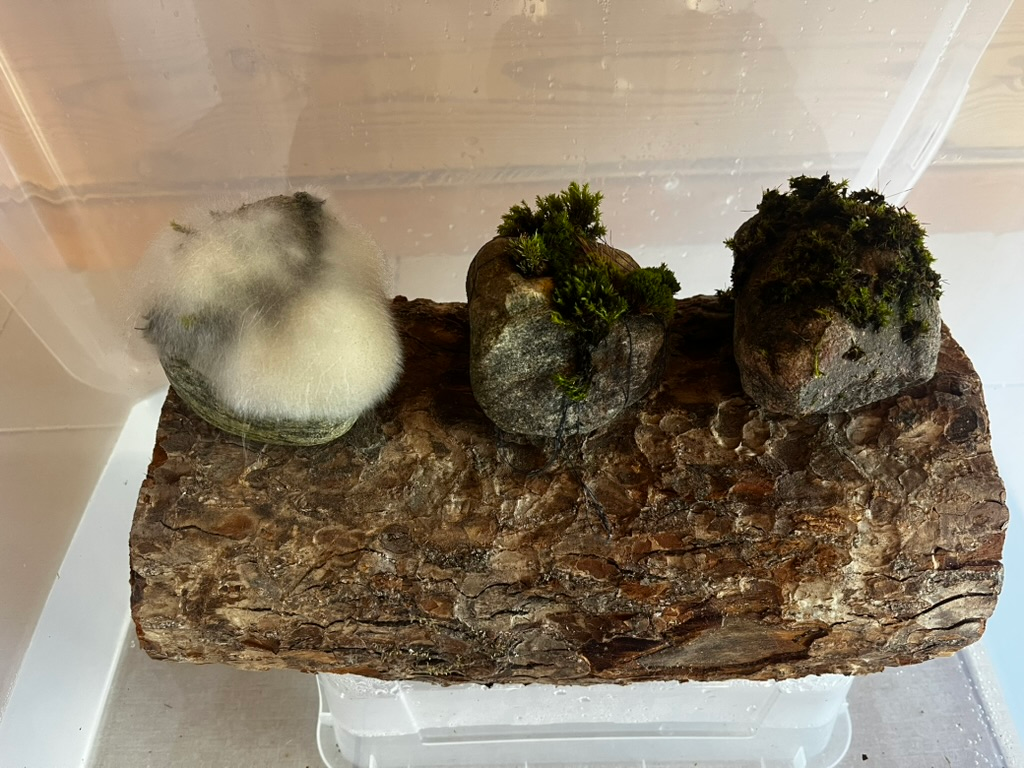
Moss is a super slow grower, but I’ve been hearing about this moss cocktail for ages now, so I got bored this winter and decided to experiment growing moss myself.
I’ve collected some moss from rocks and tried 3 different “recipes” using just string, just water and a yoghurt mix. Full details and results of my experiment are coming up.
Spoiler alert: here is a picture of one of them after just 4 days – can you guess which?
Hopefully you didn’t find it too tiring to read this post. And I hope you found this list of best perennial plants useful to make ugly views magically disappear.
Happy wizarding!